
Five Years
Sport’s accelerating cycles and Jesse Owens, fact as fiction

“We've got five years, my brain hurts a lot
Five years, that's all we've got”
David Bowie
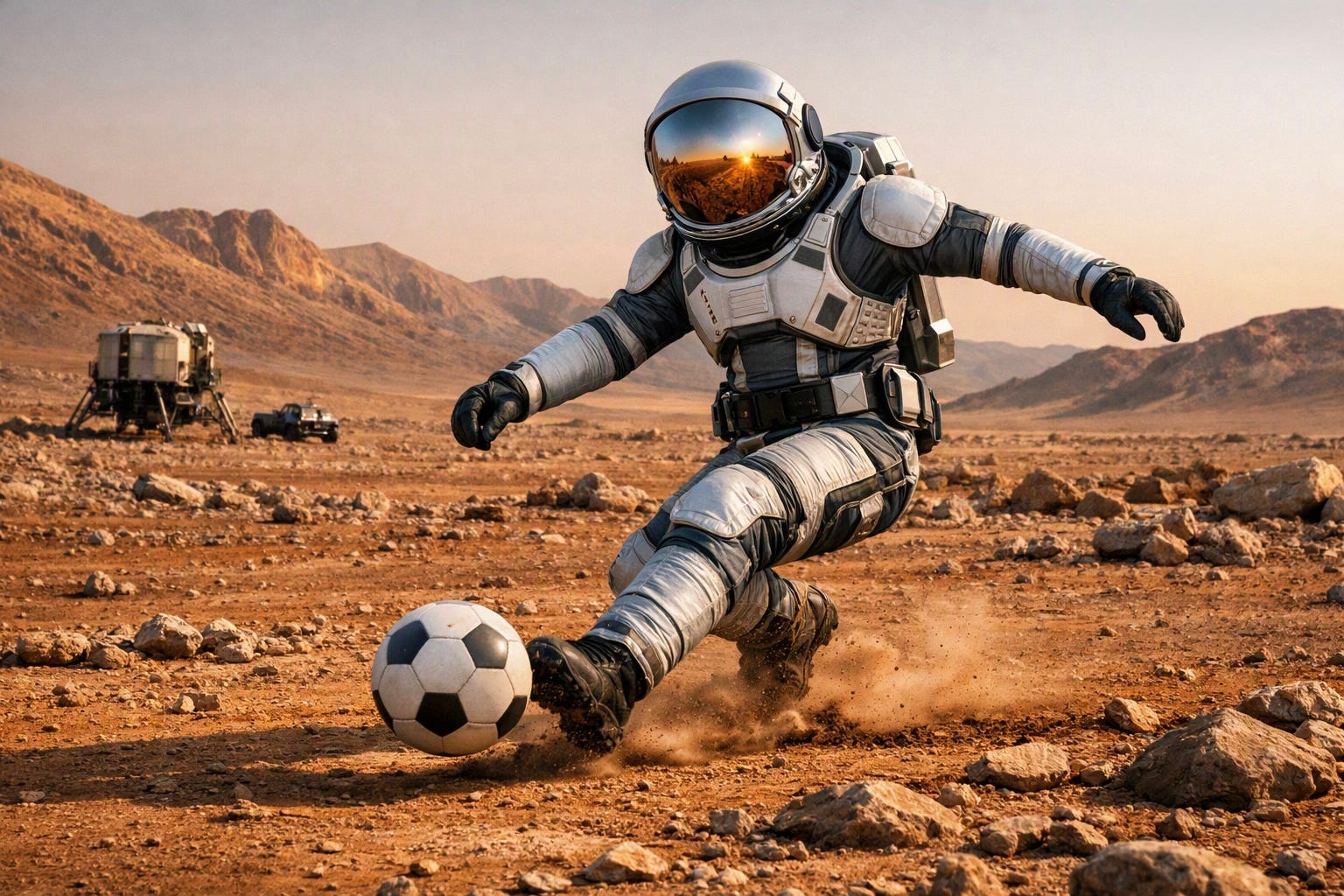
This Sport inc. newsletter has just reached its fifth anniversary. The book of the same name is three years older. In this short span of time, sporting kingdoms have risen and fallen, power shifts have accelerated and the industry’s traditional financial props have been kicked away. If Elon Musk is to be believed, man will be on Mars five years hence. In place of Alan Shepherd’s lunar 6-iron back in 1971, will we see a Martian strike from Cristiano Ronaldo before Sport inc. reaches double digits? Or perhaps Roger Federer playing Rafael Nadal at padel on the red planet?
The pace of change in sport has accelerated beyond any of my original expectations when first addressing a blank Sport inc. screen. LIV Golf has been and almost gone, Bazball’s moment in cricketing history spanned just four years, Russia was first exiled from global competition and is now being ushered back in from the cold, the Commonwealth Games has gone from triumph to life support to current resuscitation, linear broadcasters have been swept away by streamers, athletes are seizing control from sport’s bureaucrats, football and cricket are exploring their global saturation points (view the current FIFA private equity furore through this lens), the major American sports are far behind but extending their international reach at pace, women’s sport is on the rise but reliant still on financial pump-priming.
Technology explains many of these developments - indeed is the facilitator of almost all of the major trends within the sporting universe.
Only a few years ago every sports industry conference focused on the rise of streaming services. Now YouTube has conquered all of them and even the most obscure event is available to view via the platform on your screen of choice. Sporting product has proliferated and choice is seemingly limitless. Cut-through has become correspondingly difficult to secure, though. Consumers may feel they could never have too much choice, but fragmentation threatens sports, teams and athletes who find themselves mere splinters.
At the same time, social media has enabled sportspeople to bypass their employers and engage directly with fans, bending narratives to fit their chosen public images and marketing strategies crafted by their agents. Speedy delivery of personal stories challenges a sporting establishment that craves control but lacks nimbleness and struggles to compete with the celebrity status that adheres to its human products.
The world’s leading streaming services have boosted athlete celebrity through their enthusiasm for docuseries. Here too there has been a struggle for control of narratives. The first series of Sunderland ‘Til I Die and Drive to Survive already feel an age ago, their edge of authenticity having given way to highly polished PR messaging across the genre. But the stars remain front and centre of each supposed exposé series.
The result has been a surge in the value adhering to athletes capable of generating true fan engagement. In turn, this has given impetus to collective bargaining in sports dependent on a broad cohort of participants, even if a handful of their stars corner the commercial market. Right now, the world’s leading tennis players are fronting calls for a bigger share of broadcast revenues to be distributed as prize money, conscious that their own success rests in part on the existence of the competitors below them.
You would never see similar collectivism in boxing, of course. This is the sport that most starkly demonstrates the overall industry’s trends. Bouts between influencers? Tyson Fury v Anthony Joshua? Both evidence that celebrity, notoriety and mass recognition outrank athletic prowess in a world of monetised clicks.
Those sports and organisations attempting to ignore the shift in economic power consequent on disintermediated fan engagement are doomed to struggle. What hope for the Olympics when promising young athletes (and their parents) survey the disparity in potential rewards across sports and make their early life choices? The $10 million prize-pot at September’s inaugural World Athletics Ultimate Championships should be viewed in this light. And yet the IOC continues to face the incoming tide Canute-like.
Our screen-dominated world has encouraged an influx of money into the sporting industry, much of it doomed to be lost unless investors can find greater fools further down the line. Celebrities, from within and outside sport, appear eager to have their names associated with its glamour. Private equity players have jostled to feed the maw, constructing spreadsheets replete with heroic assumptions, dazzled by the sports industry’s (relatively few) financial successes. Crypto riches have seeped in around the edges.
This new money has inflated athlete values still further, both their salaries and where relevant their value as assets. When the Sport inc. newsletter launched, the record transfer fee paid by an English football team stood at the £89 million shelled out by Man United for Paul Pogba in 2016. That’s £125 million in today’s money, outranking the £117 million Chelsea has just paid for Morgan Rogers - a nominal English record. What any fan knows, however, is that average prices for average players have risen relentlessly. And not just in the top flight. Wages too, as contractual power has shifted from club to player. The influx of new money into football isn’t just about stadium redevelopment.
On days when my glass if half empty, I look for signs that sporting cycles have peaked. A headline in The Times at the weekend, for example, declared: “Hundred attendances 18% down - despite bigger stars and fresh branding.”
New money, young product, much hype. All dependent on the greater fool theory, or justified by possible future broadcast deals? Meanwhile a slew of sports administrators and investors are brainstorming new event formats - aka monetisable content - unprepared to confront the possibility that less might actually prove to be more lucrative in the long run.
What seems certain is that continued proliferation and fragmentation will widen the gulf between sport’s haves and have-nots; that the expectation of low-cost remote access to sport means many participants will go the wall. Whether as fans we will feel emotionally richer five years hence is decidedly moot.
For now, I’m still buckled in for the ride, eager to find out where this rocket lands.
Down the dustpipe
Monday marks the 90th anniversary of Jesse Owens’ 100m gold at the Berlin Olympics, the first of his four that Games.
By pure coincidence, I’m currently reading Cool Machine, the final book in Colson Whitehead’s exhilarating Harlem Shuffle trilogy. A central storyline is the 1981 theft of one of Owens’ medals from the Waldorf Astoria, where it was on display before being auctioned.
A quick Google search reveals this to be pure fiction, but also that one of the four golds was indeed sold at auction in 2013 for $1.47 million. At the time, the whereabouts of the other three was reported to be unknown, although a second was auctioned for $615,000 in 2019. Owens has been said to have lost or given away his medals - a sad reminder of the iconic athlete’s tough post-Berlin life.
I’ll leave the (almost) final words this week to Whitehead:
“Life’ll lift you up one day and knock you down the next. Jesse Owens beats the goddamn Nazis on their home turf, thumbing his nose at Hitler himself, and a couple of years later he’s selling his medals to pay his bills. You can be the fastest man in the world but you can’t outrun the white man.”
Spare a moment for Jesse Owens on Monday and do read the Harlem Shuffle trilogy.
In one
Yesterday morning I was reading an England Golf press release that claimed 9.4 million adults had played crazy or mini golf at least once in the past 12 months. Felt like one of those hard-to-believe survey extrapolations. Only hours later I found myself wielding a putter at Crabstix Adventure Golf in Cromer. Make that 9,400,001.
Next week is England Golf’s Get into Golf Week.